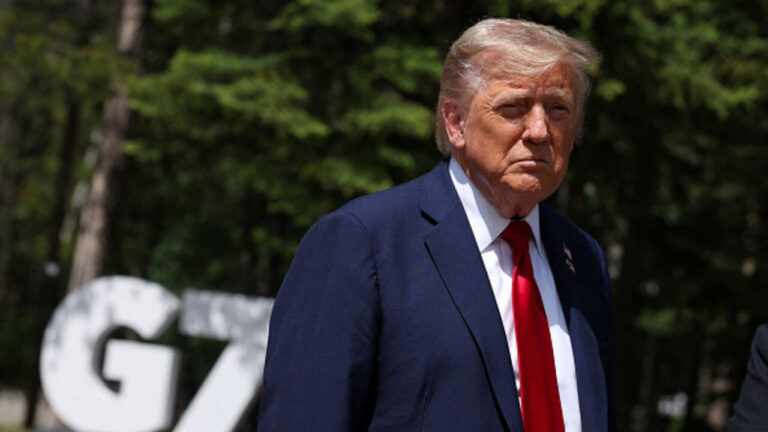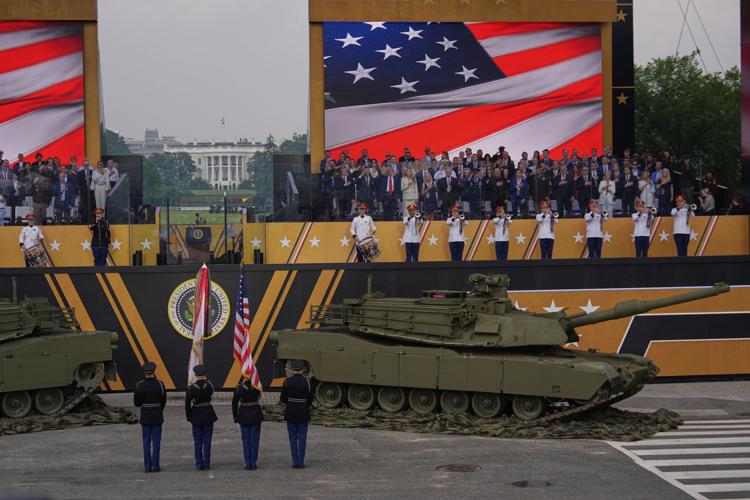
Washington D.C. witnessed a powerful military spectacle this weekend as President Donald Trump presided over a large-scale U.S. Army parade along Constitution Avenue, marking what the White House described as a tribute to American strength, history, and sacrifice. However, the event has sparked a wave of debate — some hailing it as a patriotic celebration, others condemning it as reminiscent of authoritarian displays of power.
The parade featured tanks, missile systems, fighter jets, and more than 5,000 military personnel. It was the largest such event in the United States in decades, drawing comparisons to foreign military pageantry more common in countries like Russia, China, or North Korea.
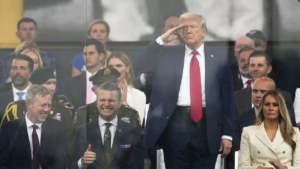
White House: “A Tribute to Our Heroes”
President Trump, speaking from a flag-draped podium near the Lincoln Memorial, praised the U.S. military for its courage and global leadership.
“Today, we honor the men and women who make our freedom possible,” he said. “America is strong, America is proud, and America will never back down.”
The event included a flyover by the U.S. Air Force Thunderbird’s, armored vehicle displays, and ceremonial salutes. Families of military veterans and active-duty personnel were invited as guests of honor. Trump declared the day a “celebration of American greatness.”
The White House said the event was designed to boost morale, promote national unity, and educate the public about the military’s role.
Critics Say Parade Crosses a Line
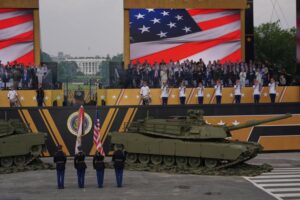
Not everyone viewed the parade as a simple patriotic event. Civil liberties groups, some members of Congress, and international observers criticized the scale and tone of the display.
Senator Elizabeth Warren called it “a taxpayer-funded campaign rally in camouflage,” while Representative Alexandria Ocasio-Cortez said, “This is not who we are. We don’t need tanks in our streets to be proud of our military.”
Others compared the parade to authoritarian-style demonstrations used by autocratic regimes to showcase control and dominance. Some veterans also expressed discomfort, arguing that the military should remain apolitical and not be used for public spectacle.
A number of commentators and political analysts labeled the event “a step toward militarized nationalism” and questioned its timing — coming amid heightened tensions abroad and ongoing criticism of Trump’s leadership style.
Public Opinion Divided
Polls conducted before and after the event show mixed reactions from the public. About 48% of respondents in a recent Gallup survey said they supported the parade, while 42% said they opposed it. Support was highest among Trump’s core voter base and military families, while opposition was strongest among urban and younger demographics.
In interviews on the ground, some attendees described the event as “inspiring,” “long overdue,” and “a reminder of our strength,” while others called it “excessive” and “a show of ego.”
International Response
Global reactions were equally divided. Russian state media praised the parade, calling it a “sign that the United States is returning to its role as a hard-power leader.” In contrast, several European newspapers criticized it as “over-the-top,” with headlines questioning if America was shifting toward a more militarized identity under Trump’s leadership.
China’s Foreign Ministry issued a cautious statement, saying it “respects all nations’ right to national celebrations” but warned against “provocative displays that may lead to misunderstanding.”
Cost and Logistics
According to early estimates, the parade cost approximately $90 million — a sum that raised eyebrows in Congress. Critics questioned whether such a display was necessary at a time when domestic programs face budget cuts and many military families continue to struggle with healthcare and housing.
The Department of Defense defended the spending, saying it promoted recruitment, morale, and civil-military understanding. “This was not just a show — it was a demonstration of values,” said Pentagon spokesperson Lt. Col. Sarah Kessler.
Legacy of the Parade
This is not the first time President Trump has flirted with military-style demonstrations. In 2019, he held a scaled-down “Salute to America” on July 4th. But this year’s event was far more ambitious, both in scope and symbolism.
Whether this parade becomes a new American tradition or remains a one-time showpiece remains uncertain. What is clear, however, is that Trump’s presidency continues to challenge established norms — and that the optics of power are increasingly central to his political messaging.
Conclusion: Celebration or Warning Sign?
To supporters, the parade was a stirring salute to American military excellence. To critics, it was a dangerous flirtation with authoritarian symbolism. As the 2024 election campaign continues and global tensions remain high, events like these will likely be scrutinized for what they signal about America’s identity — both to its citizens and the world.