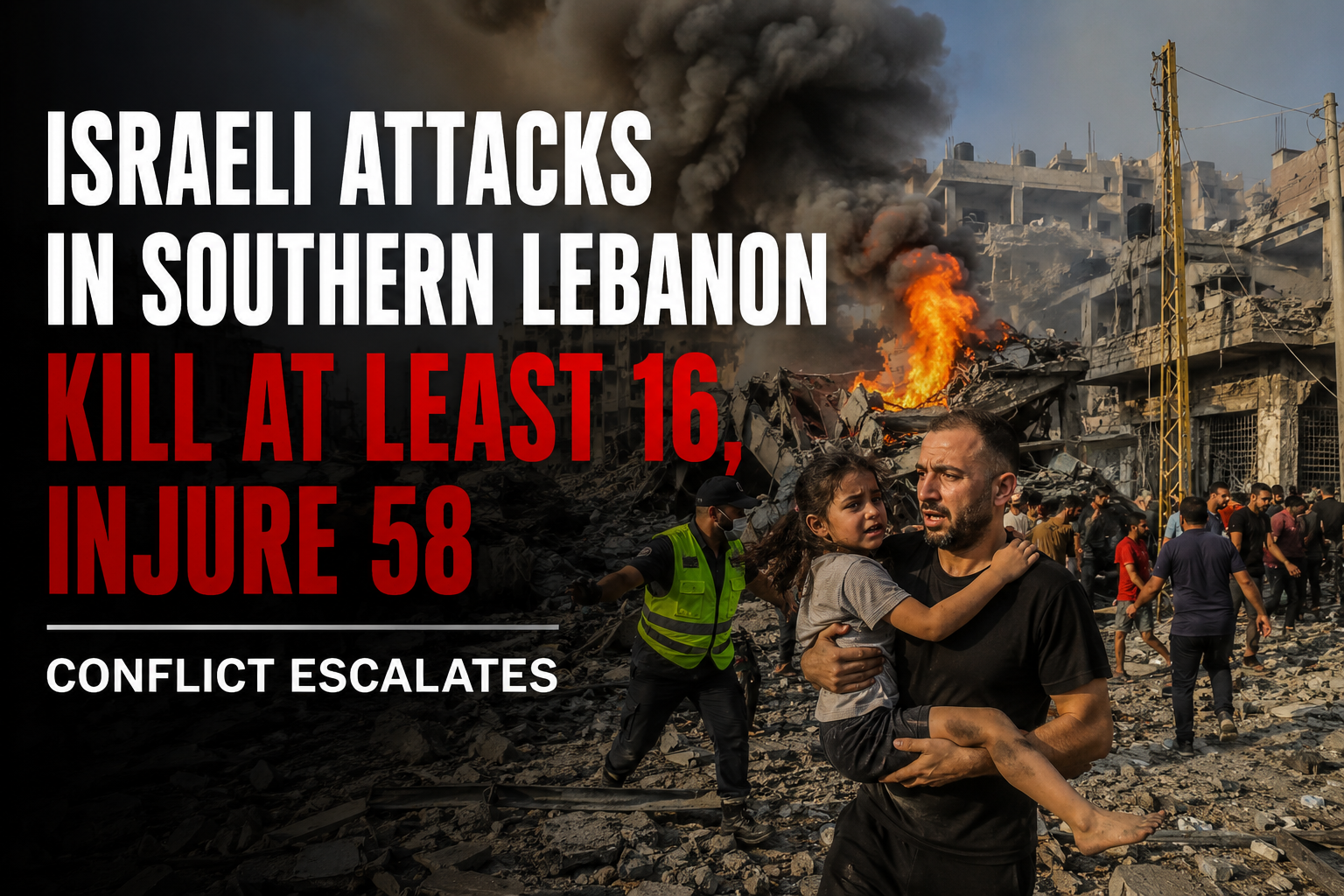
Beirut, Lebanon — Violence in southern Lebanon intensified on Wednesday as Israeli military strikes killed at least 16 people and injured 58 others, according to Lebanese health authorities. The latest attacks come amid a significant escalation in hostilities along the Israel-Lebanon border, raising fears of a broader regional conflict and worsening an already severe humanitarian situation.
The strikes were reported across multiple locations in southern Lebanon, where residents have been facing continuous military operations and growing displacement. Local officials said emergency services were struggling to respond to the increasing number of casualties as attacks continued throughout the day.
Israel has also issued large-scale evacuation warnings for several areas in southern Lebanon. The warnings have prompted thousands of civilians to leave their homes and seek shelter in safer regions further north. Many families have packed essential belongings and moved quickly, uncertain about when or whether they will be able to return.
Israeli military officials stated that the operations are aimed at degrading the capabilities of Hezbollah, the powerful Lebanese armed group and political movement that has been involved in cross-border clashes with Israel. According to Israeli authorities, military infrastructure, weapons storage sites, and command positions were among the targets of the latest strikes.
However, Lebanese officials and humanitarian organizations have expressed concern about the impact of the attacks on civilians. They argue that densely populated areas are bearing the consequences of the ongoing conflict, with homes, roads, and public facilities suffering extensive damage.
Residents in several affected towns described scenes of destruction following the strikes. Buildings were damaged or destroyed, vehicles were left burned on roadsides, and rescue teams worked through the rubble in search of survivors. Hospitals in nearby cities reportedly received dozens of wounded individuals, placing additional pressure on medical facilities already operating under difficult conditions.
The latest escalation marks another chapter in the long-running tensions between Israel and Hezbollah. The border region has experienced repeated periods of violence over the years, but recent developments suggest a broader and more sustained military campaign.
Security analysts note that both sides have increased military activity in recent weeks. Israeli officials have repeatedly stated that they are determined to prevent attacks originating from Lebanese territory, while Hezbollah has maintained that it will continue responding to Israeli military actions in the region.
The conflict has created growing uncertainty for civilians living near the border. Schools, businesses, and public services have been disrupted in many communities, while agricultural activities—an important source of income for southern Lebanon—have been severely affected.
Humanitarian organizations have warned that continued fighting could trigger a larger displacement crisis. Thousands of people have already left their homes, and aid groups are working to provide food, water, medical supplies, and temporary shelter to affected families. Relief workers have emphasized the need for safe access to conflict zones so that assistance can reach those in need.
International concern over the situation is also increasing. Several governments and international organizations have called for restraint and urged all parties to avoid actions that could further escalate the conflict. Diplomatic efforts are reportedly underway to prevent the violence from spreading beyond the immediate border area.
Regional observers fear that a prolonged confrontation could have consequences far beyond Lebanon and Israel. The Middle East remains a highly sensitive geopolitical region, and any major escalation carries the risk of drawing in additional actors and creating wider instability.
Economic concerns are also emerging as the conflict intensifies. Lebanon, already facing significant economic challenges, may struggle to cope with additional damage to infrastructure and disruptions to trade and transportation networks. Local businesses in affected areas have reported losses as residents flee and commercial activity slows.
Meanwhile, families displaced by the fighting face difficult decisions about where to go and how long they may be forced to remain away from their homes. Many are relying on relatives, community support networks, or temporary shelters established by local authorities and aid organizations.
Political leaders in Lebanon have condemned the attacks and called on the international community to intervene. They argue that civilian lives must be protected and that efforts should focus on preventing further escalation. Israeli officials, on the other hand, maintain that military operations are necessary to address security threats and protect communities near the border.
The situation remains fluid, with reports of additional military activity emerging throughout the day. Residents in several southern districts have continued to receive warnings about potential future strikes, contributing to an atmosphere of fear and uncertainty.
As the conflict develops, humanitarian agencies are urging all parties to respect international humanitarian law and take measures to protect civilians. Medical organizations have stressed the importance of ensuring access to healthcare services for the wounded and maintaining safe corridors for emergency responders.
For now, the people of southern Lebanon remain caught in the middle of an increasingly dangerous confrontation. With casualties rising, displacement growing, and diplomatic solutions still uncertain, the region faces a critical moment that could shape the trajectory of the conflict in the days and weeks ahead.
The international community continues to monitor events closely, hoping that efforts to reduce tensions will succeed before the situation deteriorates further. Until then, civilians on both sides of the border remain vulnerable to the consequences of a conflict that shows few signs of easing.
About the Author