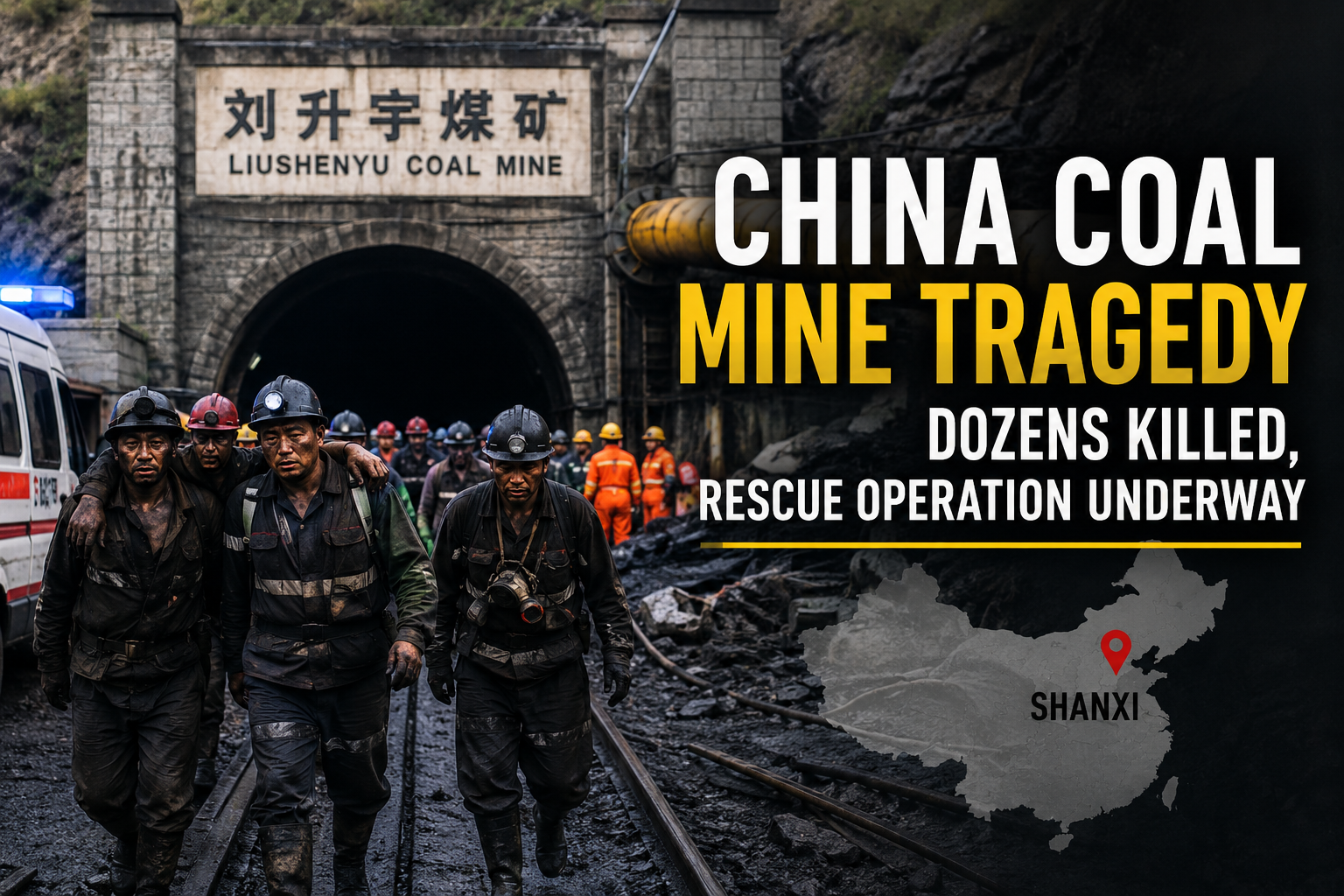
China once again faces serious concerns over industrial safety after a deadly accident at a coal mine in Shanxi Province triggered a massive rescue operation and drew national attention. The incident, which reportedly involved an underground gas explosion followed by rising toxic gas levels, has become one of the most significant mining disasters in the country in recent years.
The accident occurred at the Liushenyu coal mine near Changzhi City, a major coal-producing region in northern China. According to preliminary reports from local authorities and state media, hundreds of miners were working underground when the emergency took place. Rescue teams were immediately dispatched as communication with several workers inside the mine was lost.
Early reports suggested that dozens of workers were trapped underground while many others managed to escape or were rescued within the first few hours. Chinese authorities later confirmed multiple deaths, though the exact number has varied across reports as rescue efforts continue and conditions inside the mine remain dangerous.
Rescue Operation Underway
Emergency response teams from several departments, including mining safety agencies, firefighters, medical units, and local government authorities, were mobilized quickly after the incident. Specialized rescue crews equipped with oxygen systems and underground detection devices entered the mine to search for survivors.
State media showed images of ambulances, emergency command centers, and rescue workers gathering outside the mining area. Medical staff were also placed on standby in nearby hospitals to treat injured workers.
Officials stated that one of the biggest challenges facing rescuers was the unstable underground environment. High levels of carbon monoxide and the possibility of additional explosions reportedly complicated rescue operations. Ventilation systems inside the mine were being closely monitored to reduce the risk to emergency workers.
Chinese President Xi Jinping reportedly ordered authorities to use every possible resource to save trapped miners and investigate the cause of the disaster. National safety regulators were also instructed to carry out inspections at mining facilities across the region.
Importance of Shanxi’s Coal Industry
Shanxi Province plays a central role in China’s energy sector. Often referred to as the “coal capital” of China, the province contains some of the country’s largest coal reserves and supports thousands of mining operations. Coal continues to remain a major energy source for China despite the country’s increasing investment in renewable energy.
China is currently the world’s largest producer and consumer of coal. The fuel remains essential for electricity generation, steel production, and heavy industry. Because of this dependence, mining activity remains intense in several regions, especially in northern provinces such as Shanxi, Inner Mongolia, and Shaanxi.
However, the industry has long faced criticism over worker safety, environmental damage, and poor oversight in smaller or privately operated mines. Although China has significantly improved mining regulations over the last two decades, serious accidents still occur from time to time.
Safety Concerns Return to the Spotlight
The latest tragedy has once again sparked public debate over industrial safety standards in China. Experts believe underground gas explosions remain one of the most dangerous risks in coal mining. Methane gas can accumulate inside tunnels and ignite if ventilation systems fail or if proper monitoring is not maintained.
In many cases, accidents are linked to weak enforcement of safety protocols, aging infrastructure, or pressure to maintain high production levels. Some analysts say rising energy demand can sometimes encourage mining operators to increase output rapidly, potentially creating unsafe working conditions.
Chinese authorities have repeatedly promised stronger supervision of high-risk industries after previous mining disasters. Over the years, the government has shut down thousands of smaller mines considered unsafe or inefficient. Advanced monitoring technologies, automation systems, and stricter emergency rules have also been introduced in many large mining facilities.
Despite these efforts, mining remains one of the country’s most dangerous industries, particularly in underground coal extraction.
Public Reaction and Media Attention
News of the accident quickly spread across Chinese social media platforms, where many users expressed sympathy for the miners and their families. Others questioned whether enough was being done to improve working conditions in hazardous industries.
International media outlets also closely followed the incident due to China’s important role in global energy markets. Large mining accidents in China often attract worldwide attention because they highlight broader concerns about industrial safety, labor conditions, and energy dependency.
The disaster comes at a time when China is balancing economic growth with efforts to modernize its industrial sector. While the country continues investing heavily in solar, wind, and electric technologies, coal still remains deeply connected to its manufacturing economy.
Investigation Expected
Authorities are expected to launch a detailed investigation into the cause of the accident once rescue operations are completed. Safety inspectors will likely examine ventilation systems, gas monitoring equipment, emergency procedures, and management practices at the mine.
Experts say investigations into mining accidents often lead to temporary shutdowns and new inspections across nearby mining regions. Regulators may also introduce stricter rules if evidence of negligence or safety violations is discovered.
The long-term impact of the incident could extend beyond the mining sector. Investors, policymakers, and environmental groups may use the tragedy to renew discussions about workplace safety and China’s continued dependence on coal energy.
A Reminder of Mining Risks
For many workers in coal-producing regions, mining remains one of the few stable employment options despite its dangers. Families in industrial areas often rely heavily on the industry for income and economic survival.
The latest accident serves as a reminder that even with modern technology and tighter regulations, coal mining continues to carry serious risks. As rescue teams continue their difficult mission underground, attention remains focused on the fate of missing workers and the lessons that may emerge from yet another major industrial tragedy in China.
About the Author